
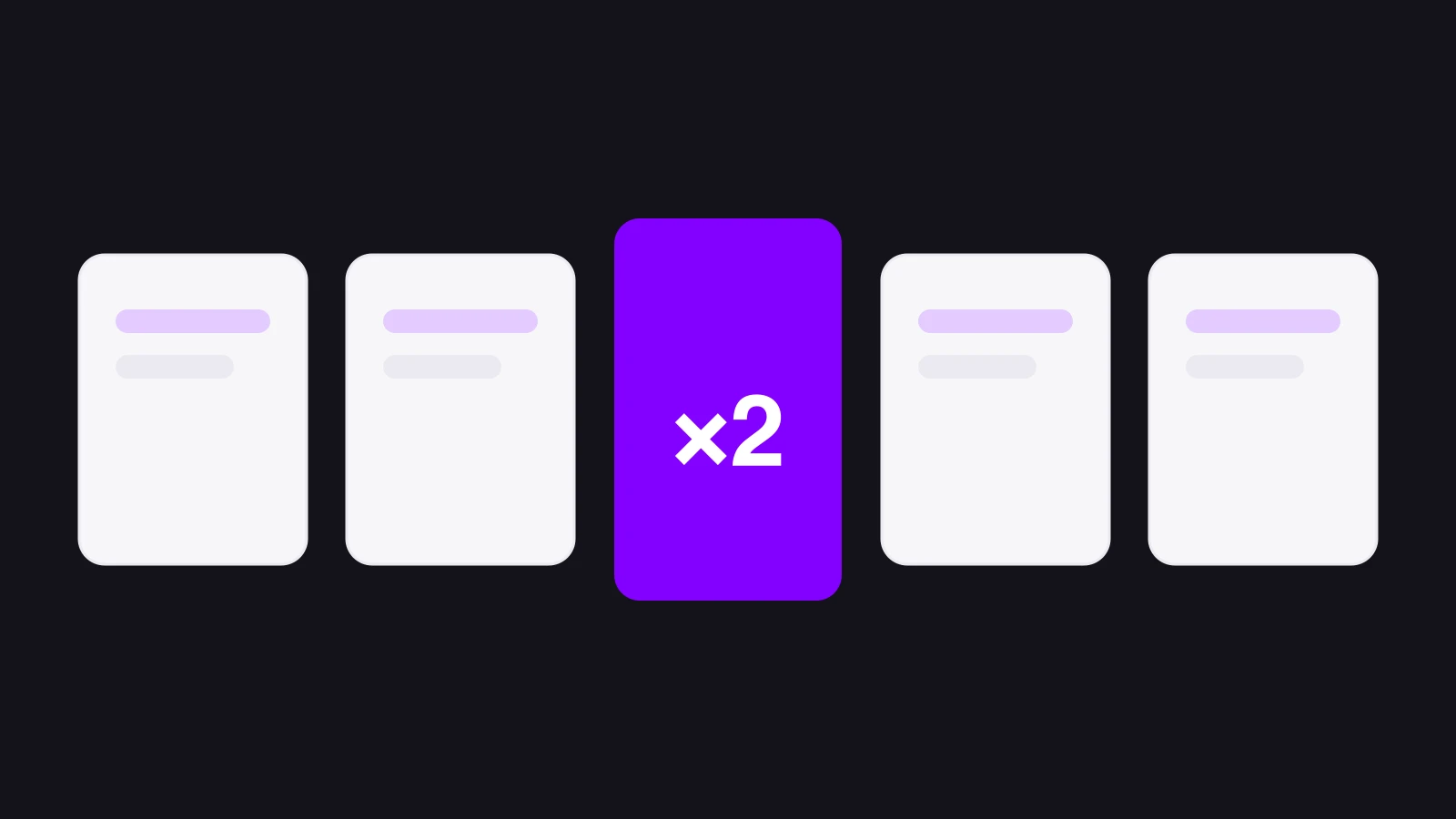
You designate exactly one of a tournament's events as THE CALL. From the tournament page that is a radio when you first submit a full slate; from Scroll it is the first event you save, which also enters you.
THE CALL doubles that event's points. One per slate; it locks when you submit. Your other probabilities stay editable until each event locks.
That is the whole mechanic. But the details around the edges are worth knowing.
The mechanics, precisely
- One per slate. Every player has exactly one CALL per tournament. From the tournament page you pick it as a radio at first submit; from Scroll it is the first event you save.
- It locks at first save. Your other probabilities stay editable until each event individually locks; your CALL does not. Designating it is a commitment you make once, up front.
- It doubles that event's points. Whatever the scoring rule pays you on that event, THE CALL pays twice. A 91 becomes a 182. A 36 becomes a 72.
- It is per player, not per ticket. If you hold multiple tickets in a tournament, they all share one slate and one CALL.
If your CALL event is voided
Occasionally an event cannot be fairly resolved and is voided under the rulebook. If that event was your CALL and the void lands before the event locked, you may re-designate: pick a new CALL from your still-open events. A void after lock never reopens the choice, because picking with hindsight would turn THE CALL into a free option. In every case where you do not (or cannot) re-pick, the doubling is settled using your own average score instead, so a void never silently costs you the multiplier. The exact procedure lives in the rules page.
What it does to the leaderboard
Doubling one event raises the stakes on a single judgement. Two players with identical slates can finish apart because they aimed their CALL at different events. It concentrates risk by design: where you point it is up to you, and the standings remember it.